

If you run a trade or service business in Canterbury, most of this will feel abstract. Your search results probably look similar to how they looked a year ago. So before anyone declares the sky is falling, here is what is actually happening, what the data shows, and what it means for your website in plain terms.
This has been building for a while
The I/O 2026 announcements were not a rupture. They were confirmation of a direction that has been in motion for years.
The clearest evidence is in the numbers. AI Overviews, the feature that places an AI-generated summary above the traditional list of results, now reach 2.5 billion users globally every month. They appear in roughly 13% of all Google searches, concentrated heavily on the informational queries that small business websites have historically depended on for traffic. When an AI Overview appears for a query, the zero-click rate hits between 80 and 83%. The question gets answered. Nobody visits your website.
Taken across all Google searches, including those without an AI Overview, 60% now end without a click to any website. On mobile, that figure sits at 77%.
For businesses that built their entire digital strategy around ranking in Google and waiting for traffic to arrive, this is a structural shift, not a bad month.
What actually changed at I/O 2026
Three announcements matter for anyone running a local business website.
The search box has been rebuilt
Google describes it as the biggest redesign in 25 years. It now accepts text, images, files, videos, and browser tabs as input. It expands to accommodate long, conversational queries rather than keyword fragments. It suggests how to ask questions, not just what to search for. This changes the nature of the query itself, which in turn changes what a useful answer looks like and what kind of website gets cited as one.
AI agents now run in the background
Google’s new information agents monitor topics continuously and alert users when something relevant changes, without being asked. A customer who has set up an agent to track “best plumbers in Christchurch” or “who builds decks in Rolleston” is receiving curated recommendations from Google’s AI. Your website either makes the cut or it does not. The agent does not browse through page two of the results.
Booking and local services are becoming agentic
Google is extending its agentic booking capabilities to cover local experiences and services. The customer journey from intent to contact is being compressed. Less browsing. Less comparing. Less clicking through to your website to decide whether to call.
The new search box has begun rolling out globally. The agents are launching in the US first for paid subscribers before broader availability. The direction is clear, even if the timeline for NZ is staged.
Rankings are no longer the whole story
Here is something that many businesses do not yet understand, and that is genuinely new information even for people who have been paying attention.
Ranking well in Google no longer reliably predicts whether you appear in an AI-generated answer. The overlap between sites that hold top-ten positions and sites that get cited in AI Overviews has collapsed from 75% in mid-2025 to between 17% and 38% by early 2026. A site can rank first for a query and still be invisible in the AI response to that same query.
This matters because it separates the question of “where does my site rank” from “does Google trust my site enough to recommend it.” Those used to be the same question. They are increasingly not.
The sites that earn AI citations share recognisable traits:
- They load fast.
- They explain clearly what the business does and who it serves.
- They carry real reviews and verifiable credentials.
- They are structured in a way that machines can parse and interpret without guesswork.
- They have schema markup, the behind-the-scenes code that tells Google explicitly what kind of business this is, what services it offers, where it operates, and who stands behind it.
A controlled test cited by Search Engine Land found that when two comparable pages competed for an AI Overview, only the one with properly implemented schema markup appeared. Not the one with better prose. Not the one that ranked higher. The one the machine could read.
Sites with complete schema markup have a 2.5 times higher chance of appearing in AI-generated answers. Brands that do get cited earn 35% more organic clicks than those that do not, for the same queries.
The core update running right now
The May 2026 Core Update is live and will take up to two weeks to complete. It is worth understanding what a core update actually is before drawing any conclusions.
Core updates are not targeted penalties. They are not looking for a specific rule you broke. They are broad recalibrations of the entire ranking system, where Google re-evaluates which signals matter most and reweighs them across every site it has indexed.
The March 2026 Core Update, which wrapped up on 8 April, gives a sense of scale. During that rollout, 79.5% of URLs in the top three positions shifted. In the top ten, 90.7% of URLs moved. Only one in five sites in the top three held their exact position. That is not a tweak. That is a reshuffle.
The March cycle also coincided with a spam update running simultaneously, which complicated the picture further. The May update is arriving seven weeks later, before the dust from March had fully settled for many sites.
For local businesses with straightforward service sites, the advice from every credible source is consistent: do not make reactive changes during a rollout. Wait until the update completes, around 4 June, before drawing conclusions or making significant changes to your site.
Local is still your strongest ground
Here is the part that is often missing from coverage aimed at global audiences: local intent searches behave differently.
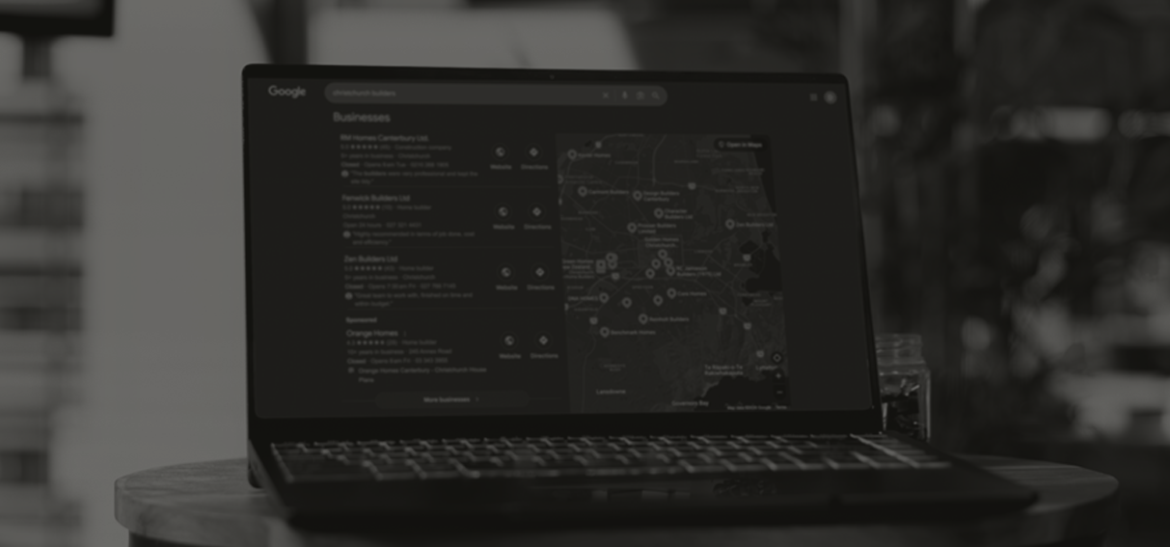
AI Overviews trigger far less often on queries with local intent. “Drain unblocking Christchurch” or “roof repairs Rangiora” are not the kind of queries that produce an AI-generated summary instead of a map and a list of businesses. Location-specific searches still largely resolve to the local map pack, Google Business Profiles, and the sites attached to them.
This is an advantage that most small trade and service businesses in Canterbury have not yet made the most of. Your competition is not a national brand with a large content team. It is the business down the road with a slightly better-structured site.
A New Zealand newswire piece published this week put it plainly: local intent is still mostly safe, and anything you can do to anchor your business to a clear geographic service area, accurate addresses, real photographs, real reviews, and real opening hours still pays a return.
The counterpoint is that Google Maps and local results are also becoming more AI-influenced. The businesses that show up in those